

Finding the right vacation home rental in Miami starts with picking a neighborhood, sizing the property to your group, and deciding how you book it. A vacation home rental in Miami booked through a third-party platform usually costs more than the same unit booked directly with the owner, because platforms tack on a service fee that a direct booking site doesn’t. Booking direct with a host like Retreats Miami typically means the total price you see is the total price you pay.
Key Takeaways
- Miami’s most requested vacation rental neighborhoods are South Beach for beach access, Brickell for urban energy near Downtown, Coconut Grove for quiet family stays, and the Design District/Buena Vista area for shopping and galleries.
- Miami-Dade County requires a Certificate of Use before a property can legally list as a vacation rental, and a 6% county tax applies to stays of six months or less, according to the county’s Tourist and Restaurant Taxes page.
- Miami Beach adds its own layer of rules on top of county requirements: zoning restrictions plus a separate 4% city Resort Tax. Verify a listing’s Business Tax Receipt number before booking.
- AirDNA reports Miami short-term rentals averaged 55% occupancy and a $274.30 average daily rate in 2026 data, while Miami Beach specifically runs closer to $366.30 ADR at 52% occupancy.
- Booking direct with a licensed local operator generally avoids the added service fee (often 10-15% on OTAs) and gives you a single point of contact for questions before arrival.
- Group size dictates neighborhood and property type: 2-6 guests fit condos in South Beach, while reunions of 12-20 need a villa or multi-home compound in Brickell or the Design District.
Miami-Dade County welcomed a record 28.3 million visitors in 2026, according to the Greater Miami Convention & Visitors Bureau, and lodging spending alone reached $10.4 billion. Popular neighborhoods book up fast around major 2026 events like the FIFA World Cup and the College Football Playoff National Championship, both of which the GMCVB has flagged as demand catalysts for the year.
If you’ve searched “vacation home rental Miami” and landed on a wall of generic listings pages, you already know the problem: most sites treat Miami as one giant search radius instead of a set of neighborhoods with different rules, price points, and crowds. This guide breaks that down by area, walks through the direct-booking process step by step, and flags the county and city regulations that trip up first-time renters.
At Retreats Miami, we manage seven vacation rentals across South of Fifth, Brickell, North Coconut Grove, and the Design District’s Buena Vista neighborhood. We’ve hosted honeymoon couples and 20-person family reunions. The neighborhood you pick before you book matters more than almost anything else on your itinerary.
Table of Contents
- Which Vacation Home Rental Site Is Best for Miami?
- What Are the Best Miami Neighborhoods for a Vacation Home Rental?
- What Are Some Good Villas to Rent in Miami?
- What Is the Best Way to Rent a Vacation Home in Miami?
- How Do City of Miami, Miami Beach, and Unincorporated Miami-Dade Rules Differ?
- What Does a Miami Vacation Rental Actually Cost, Total?
- How Many Bedrooms Do You Need for Your Group?
- How Do You Verify a Listing Before You Book?
- When Is the Best Time to Book a Miami Vacation Rental?
- Frequently Asked Questions
Which Vacation Home Rental Site Is Best for Miami?
The best way to book a vacation home rental in Miami is through the property owner’s own website, not a third-party platform, because booking with the owner removes the service fee that Airbnb and Vrbo charge on top of the nightly rate. Platforms like Airbnb, Vrbo, Booking.com, Sonder, and Plum Guide are useful for browsing and reading reviews, but they are not the cheapest place to finalize a booking once you’ve found the right property.
Here’s how the options actually differ. Airbnb and Vrbo aggregate the largest number of Miami listings, which makes them the best starting point for research, especially for reading verified guest reviews. Booking.com functions similarly but leans more toward traditional hotels alongside rentals. Sonder and Plum Guide operate curated, managed inventories with more consistent standards but a narrower selection.
The catch with all four: their service fees typically run 10 to 15% on top of the nightly rate, plus separate cleaning fees and taxes. If you find a property you like on Airbnb, check whether the host has a booking site of their own. Many independent operators, including Retreats Miami, list the exact same properties at retreatsmiami.com without the platform markup.
What Are the Best Miami Neighborhoods for a Vacation Home Rental?
Miami’s best vacation rental neighborhoods split by trip type: South Beach for beach access and walkability, Brickell for urban energy near Downtown, North Coconut Grove for quiet family stays, and the Design District/Buena Vista for shopping and gallery access without giving up a private pool. The Greater Miami Convention & Visitors Bureau lists South Beach, Mid Beach, North Beach, Wynwood, Miami Design District, Brickell, Coconut Grove, Coral Gables, Little Havana, and Little Haiti as its official destination neighborhoods.
South Beach and South of Fifth
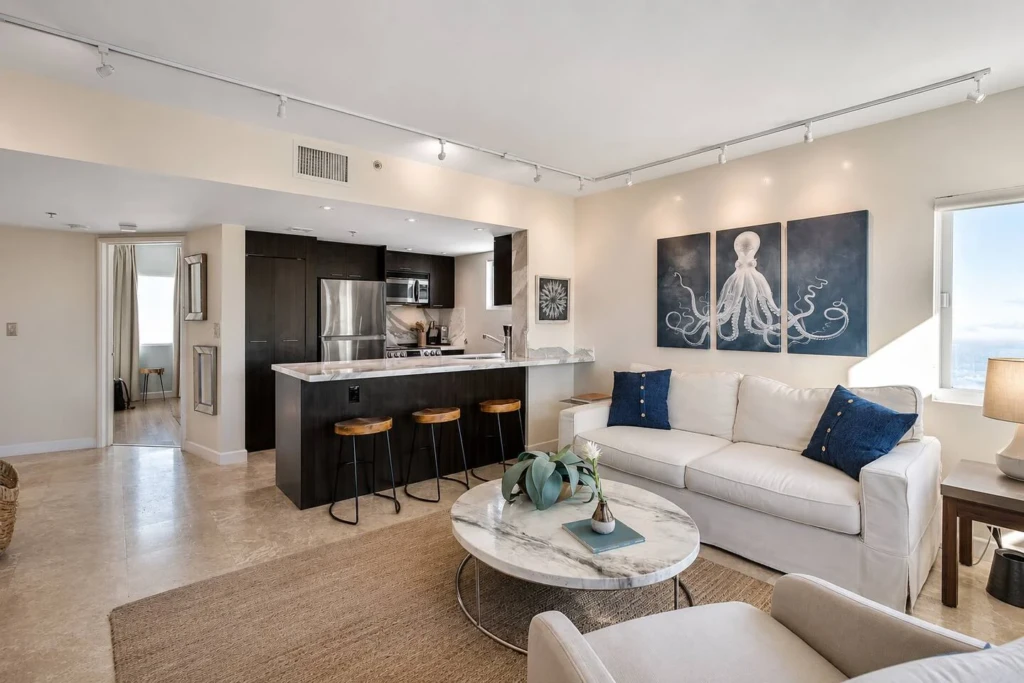
South Beach runs from South Pointe Park north to 23rd Street, and its southernmost pocket, South of Fifth, is the quietest residential stretch inside that boundary. This is where you’ll find 404th 360 Collins, a top-floor corner penthouse one block from the sand with a private balcony over the neighborhood’s pastel art deco rooftops.
This two-bedroom condo sleeps six across a king bedroom, a queen bedroom, and a queen sofa bed, and it comes stocked with beach chairs and a cooler so your first beach trip doesn’t require a shopping stop. It’s steps from South Pointe Park and a short walk to Joe’s Stone Crab, and it carries more than 330 reviews built up over a decade of hosting.
For a smaller footprint in the same block, 402nd 360 Collins fits 2-4 guests comfortably with a Juliette balcony over the street and a Walk Score of 95, meaning you can genuinely skip the rental car here.
South Beach works best for couples and small families who want to walk to dinner and the beach without a car. It works less well for anyone chasing late-night club access with a big group; the residential blocks south of 5th Street keep quiet hours, and Ocean Drive’s louder scene sits north of that boundary.
Brickell
Brickell is Miami’s financial and residential high-rise district, five minutes from Downtown and roughly 12 minutes from Miami Beach by car. 1430, a four-bedroom, three-bathroom pet-friendly villa, sits in this corridor with a heated saltwater pool, a mini-golf green, and a gas fire pit in the backyard, sleeping up to 12 guests.
Brickell suits corporate retreats and group trips that want proximity to Downtown’s restaurants and the Wynwood arts district (about 8 minutes away) without staying in South Beach’s tourist density. The 1 Gig WiFi and dedicated workspace at 1430 also make it a solid pick for teams mixing work sessions with pool time.
North Coconut Grove
North Coconut Grove is one of Miami’s oldest, quietest residential neighborhoods, known for tree canopy and mid-century architecture, with a resident peacock population that wanders the streets. 120 Shore, a six-bedroom, four-bathroom retreat here, is walking distance to the Vizcaya Museum and Gardens and just 5 minutes from Brickell by car.
This property has a private saltwater pool and a separately heated hot tub, plus an outdoor kitchen with a bar built for entertaining. It’s the right call for family reunions or multi-generational trips that want a residential, low-noise setting rather than a walkable nightlife strip.
Design District and Buena Vista
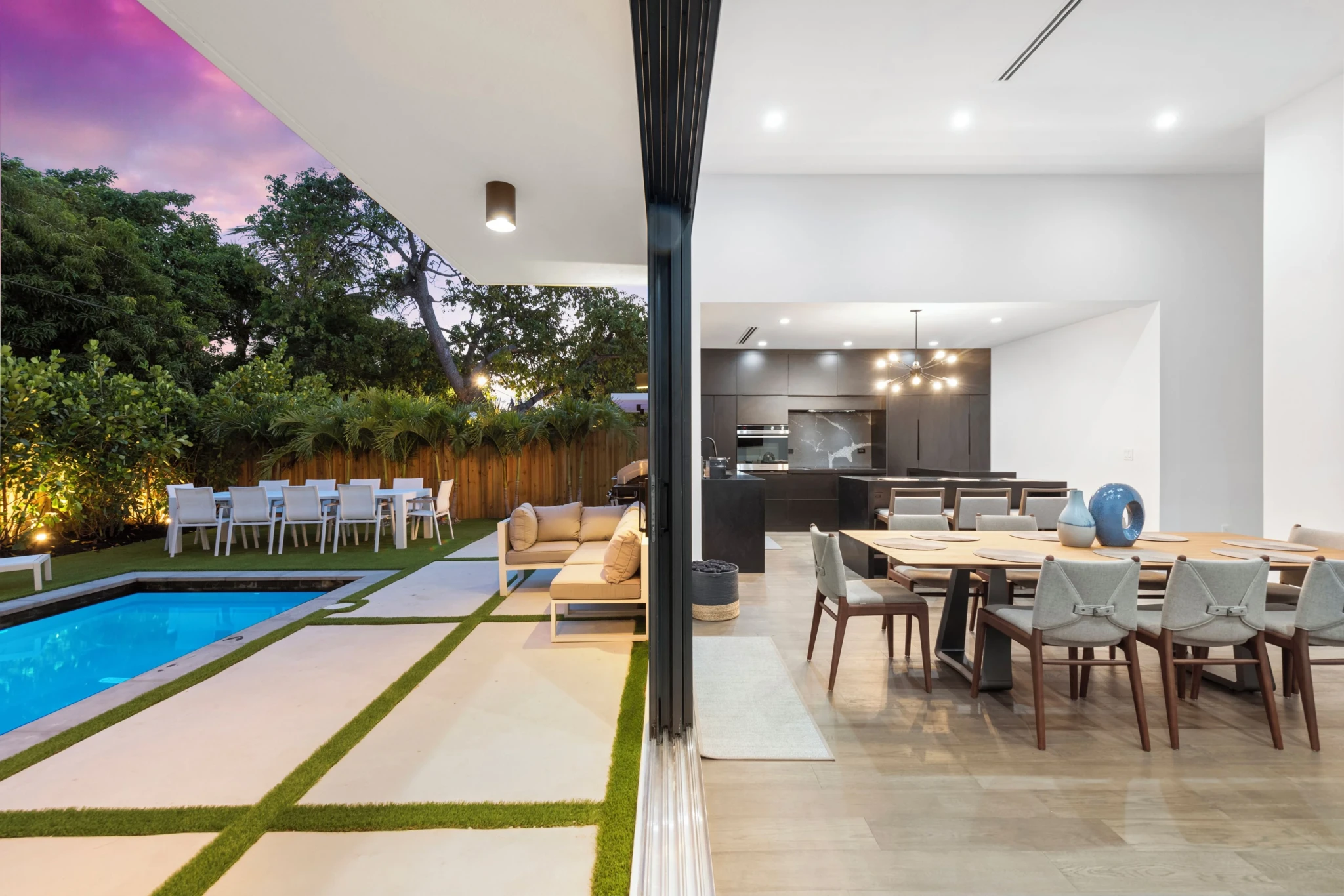
The Miami Design District is an upscale, open-air shopping and gallery district, and Buena Vista is the residential neighborhood at its edge. Three Retreats Miami properties sit here: 520, a five-bedroom new-construction villa a half-mile walk from the Design District; 530, a five-bedroom villa with a fully private, hedge-enclosed backyard and heated plunge pool; and the Compound, two connected homes totaling 10 bedrooms for groups up to 20.
All three sit within 5-10 minutes of Wynwood’s murals and galleries and roughly 10-15 minutes from Miami Beach. This area rewards groups who want walkable dining and art without giving up a private pool at home, an option South Beach’s dense condo blocks rarely offer.
What Are Some Good Villas to Rent in Miami?
A good Miami villa rental combines private outdoor space with a real kitchen and enough bedrooms that your group isn’t stacking air mattresses in the living room. Among Retreats Miami’s portfolio, the strongest villa picks depend on group size and how much outdoor entertaining you want to do.
For groups of 8-12 who want a resort feel at home, 1430 in Brickell pairs a heated saltwater pool with a fire pit and mini-golf, and it’s the only property in the portfolio that’s explicitly pet-friendly. For a quieter, more manicured setting, 120 Shore in North Coconut Grove adds a heated hot tub alongside its pool and sits within walking distance of Vizcaya’s gardens.
If privacy from neighbors is the priority, 530‘s fully enclosed backyard, rare for Miami’s Design District, comes with a heated plunge pool and a pool table indoors. And for reunions or retreats over 12 guests, the Compound‘s two gated homes sleep up to 20 without splitting your group across separate bookings.
Elsewhere in the Miami market, single-family homes in Coral Gables, Coconut Grove, and Pinecrest typically run $300-$1,500 per night. True luxury villas on Star Island or in Coral Gables can reach $1,000-$5,000 per night depending on season and size, based on published Miami rental market ranges.
What Is the Best Way to Rent a Vacation Home in Miami?
The best way to rent a vacation home in Miami is to shortlist properties on a platform like Airbnb or Vrbo for reviews and photos, then book on the owner’s website once you’ve picked a property, confirming the license number and total cost before you pay. This two-step process gets you the research benefits of a large marketplace without paying its markup.
- Define your group size and must-have amenities first (pool, pet-friendly, workspace) before searching by neighborhood.
- Search Airbnb or Vrbo to compare neighborhoods and read at least 20-30 recent reviews per property, prioritizing listings rated 4.7 or higher with reviews posted within the previous 90 days.
- Note the property name and check whether the host has an independent booking site; most legitimate local operators do.
- Confirm the license or Certificate of Use number is visible on the listing, a legal requirement discussed in the next section.
- Request the full cost breakdown from the host, including cleaning fee, security deposit, parking, and any resort or tourist taxes.
- Book with the owner and confirm your check-in process and cancellation terms in writing before paying.
Booking with the owner also means one point of contact if something changes. When you book Retreats Miami’s properties this way rather than through a third-party platform, we disclose the security deposit, house rules, and total price upfront rather than burying them across multiple confirmation emails.
How Do City of Miami, Miami Beach, and Unincorporated Miami-Dade Rules Differ?
Miami vacation rental regulations vary by exact jurisdiction: the City of Miami, the City of Miami Beach, and unincorporated Miami-Dade County each enforce separate rules, and a property’s legal status depends entirely on which one it sits in. This is the single most confusing part of Miami vacation rental research, and most guides skip it entirely.
In unincorporated Miami-Dade County, Section 33-28 of the county code requires an owner to obtain a Certificate of Use before listing a property as a vacation rental, and the application must acknowledge Florida Department of Business and Professional Regulation licensing and Florida Department of Revenue tax registration. Occupancy in these areas caps at two persons per bedroom plus two additional people, up to 12 overnight guests total, excluding children under three.
Miami Beach layers its own restrictions on top. The city prohibits short-term rentals in all single-family homes and many multifamily buildings in specified zoning districts, and any approved listing must display its city-issued Business Tax Receipt number and Resort Tax certificate number. Miami Beach guidance warns that renting an unauthorized property can result in visitor eviction and fines against the owner; you can check a property’s status through the city’s Practice Safe Renting portal before booking.
If a property sits inside a different municipality entirely, county rules don’t apply, and you’ll need to check that city’s own regulations. When in doubt, ask the host for their Certificate of Use or Business Tax Receipt number; a legitimate operator will produce it without hesitation.
What Does a Miami Vacation Rental Actually Cost, Total?
The real cost of a Miami vacation home rental is the nightly rate plus cleaning fee, refundable security deposit, applicable taxes, and parking, and skipping any one of these when comparing listings leads to sticker shock at checkout. A typical one- to three-bedroom Miami rental runs roughly $150-$500 per night before fees.
Here’s a total-cost worksheet most listing sites don’t walk you through:
| Cost Component | Typical Range or Rate | Notes |
|---|---|---|
| Nightly rate | $150-$5,000 | Varies by property type, bedrooms, and season |
| Miami-Dade County tax | 6% of rental amount | Applies to stays of six months or less, per Miami-Dade’s tax office |
| Miami Beach Resort Tax | 4% additional (city-specific) | On top of county tax, for Miami Beach properties only |
| Cleaning fee | Set per property | Confirm this is disclosed upfront, not added at checkout |
| Refundable security deposit | $250-$1,000 (varies by property) | Collected separately after booking; not part of nightly total |
| Parking | Varies (some include a free spot) | Confirm garage vs. street parking before arrival |
| OTA service fee (if booking via platform) | Roughly 10-15% | Avoided when booking with the owner |
For context on the deposit line: 404th 360 Collins collects a refundable $350 deposit, 402nd 360 Collins collects $250, 1430 collects $500, and 120 Shore collects $1,000, each tied to the property’s size and amenity level. Asking for this breakdown before you book, rather than after, is the easiest way to avoid a surprise at checkout.
How Many Bedrooms Do You Need for Your Group?
The right bedroom count for a Miami vacation rental depends on group composition, not just headcount: couples traveling together generally want separate primary suites, while families with kids need a crib and high chair rather than an extra bedroom. Miami-Dade’s occupancy standard for unincorporated areas allows up to two people per bedroom plus two additional guests, capped at 12 overnight.
For a bachelorette weekend of 6-10, a two-bedroom condo works only if everyone is comfortable sharing a sofa bed; most groups this size are better served by a 4-5 bedroom villa like 1430 or 520. For a couple’s getaway or a small family of four, a two-bedroom unit like 404th 360 Collins, with its king and queen bedrooms at opposite ends of the floor plan, keeps two parties from crossing paths.
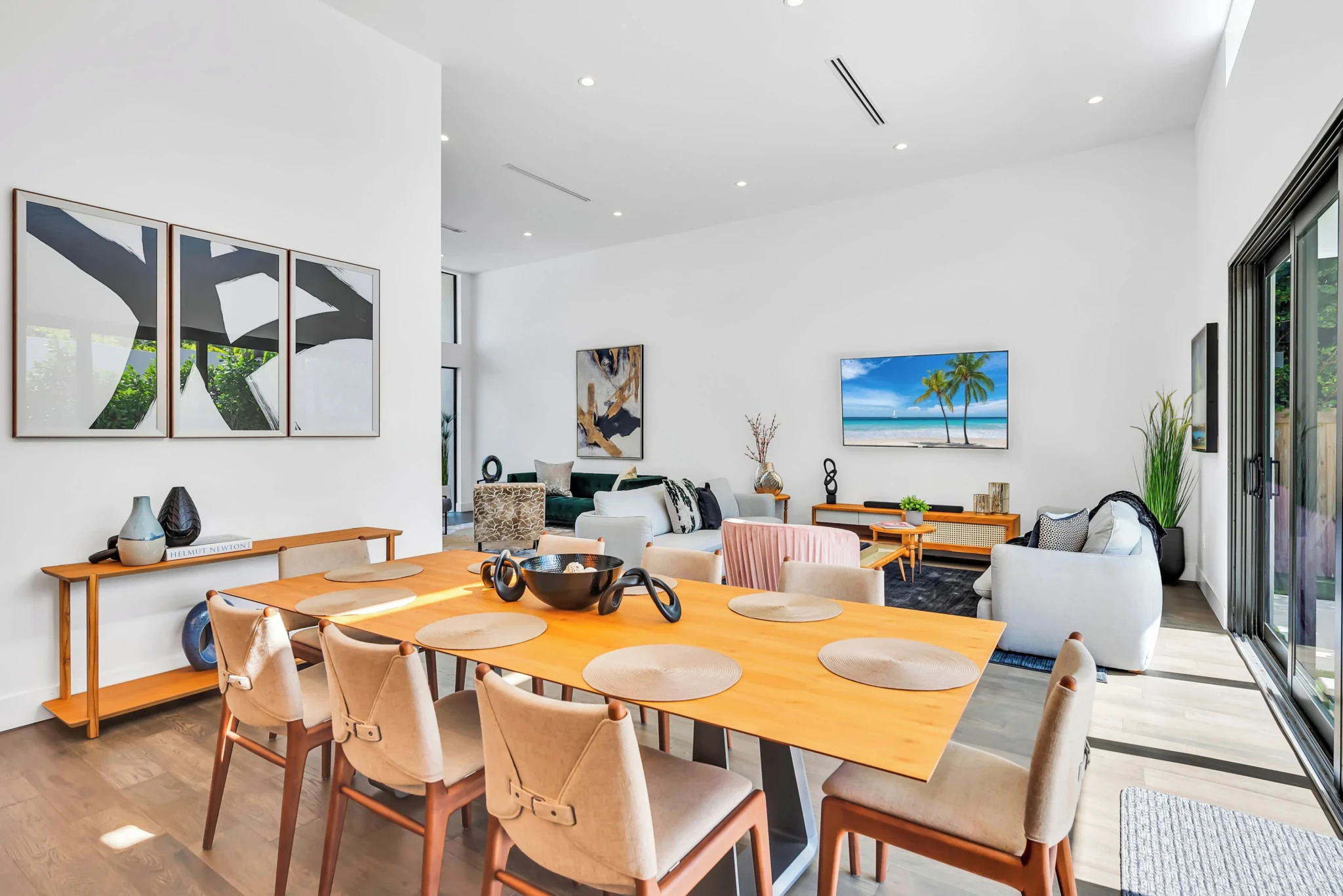
Family reunions spanning grandparents to toddlers need separated living zones as much as raw bedroom count. 120 Shore’s two separate primary suites, each with an ensuite bath, let two sets of parents avoid sharing a bathroom, while its crib, high chair, and baby monitor cover the youngest guests. For reunions over 12 people, splitting across two condos gets expensive and logistically messy; the Compound’s 10 bedrooms across two connected homes solves that in a single booking.
How Do You Verify a Listing Before You Book?
Verifying a Miami vacation rental listing means confirming its legal status, checking recent reviews, and cross-referencing photos against the actual unit number before paying anything. Most guests check reviews before booking a vacation rental, but reviews alone don’t confirm a listing is legally operating.
Run through this checklist before you commit:
- Ask for the Certificate of Use number (unincorporated Miami-Dade) or Business Tax Receipt and Resort Tax certificate number (Miami Beach) and confirm it matches the address.
- Check that reviews are recent, ideally within the last 90 days, and read a few 3-star reviews, not just the top ones, since hosts sometimes hide critical feedback lower in the list.
- Confirm the listed amenities in writing; a “pool” or “pet-friendly” claim should match the property’s actual amenities before you book, not after you arrive.
- Ask how check-in works, whether it’s a smart lock, lockbox, or in-person handoff, and whether the host is on-site or reachable 24/7 by phone or message.
- Get the total cost breakdown, including the security deposit amount and refund timeline, in writing before paying.
A legitimate operator with over a decade of hosting, like the team behind 404th 360 Collins with its 330-plus reviews, will have no issue producing licensing details and a clear fee breakdown on request. If a host hesitates or gets vague about a Certificate of Use, that’s a signal to keep looking.
When Is the Best Time to Book a Miami Vacation Rental?
Book a Miami vacation rental 3-6 weeks before travel for most trips, though major 2026 events will compress that window significantly for South Beach and Brickell properties. Industry booking-window data has put the typical U.S. vacation rental booking lead time at just over three weeks in recent years, with average length of stay stretching to around 4-5 nights.
Miami’s hurricane season runs roughly June through November. It rarely cancels a trip outright, but it’s smart to book a property with a flexible cancellation policy during those months and recheck the forecast about a week out. Weekday rates also run noticeably lower than weekends across most Miami rentals, and weekend occupancy typically runs well above weekday occupancy in coastal markets nationally.
Specifically for 2026, the GMCVB has flagged the FIFA World Cup, the College Football Playoff National Championship, the World Baseball Classic, and PGA Tour and NASCAR Cup Series Championship events as major demand catalysts. If your trip overlaps with any of these, book your neighborhood of choice as early as possible; South Beach and Brickell inventory tightens first. A meaningful share of vacation rental bookings nationally happen within a week of check-in, but Miami’s event calendar makes last-minute booking a gamble during peak weeks.
What Should You Skip When Renting a Miami Vacation Home?
Skip booking a South Beach condo expecting late-night club noise unless you specifically want it; the residential blocks in South of Fifth, including the area around 404th 360 Collins, keep quiet hours from 10pm and are built for restful nights. If your group wants Ocean Drive’s club scene, look further north on Collins Avenue instead.
Skip assuming every Design District property is pet-friendly. Among Retreats Miami’s portfolio, only 1430 in Brickell explicitly welcomes pets; the Design District villas are built for families and small groups without that accommodation. Confirm pet policy with the host rather than assuming.
And skip nightly-rate comparisons that ignore taxes. A $250/night South Beach condo and a $300/night Brickell villa can land at nearly the same total once Miami-Dade’s 6% tax, Miami Beach’s added 4% Resort Tax (where applicable), and cleaning fees are factored in. Always ask for the all-in total, not the headline rate.
Conclusion: Picking Your Miami Vacation Home Rental
The right vacation home rental in Miami comes down to matching your group’s size and trip style to the correct neighborhood, then verifying the listing’s legal status before you pay. South Beach and South of Fifth suit couples and small families who want to walk to the water. Brickell and the Design District suit larger groups who want pool time and easy access to Downtown or Wynwood. North Coconut Grove suits quieter, multi-generational reunions.
Booking with the owner, rather than through Airbnb or Vrbo, typically saves the 10-15% service fee those platforms add at checkout, and it puts you in contact with the operator managing your stay. As Miami’s visitor numbers keep climbing toward 2026’s event-driven peak, that relationship matters more when availability tightens in the neighborhoods people actually want.
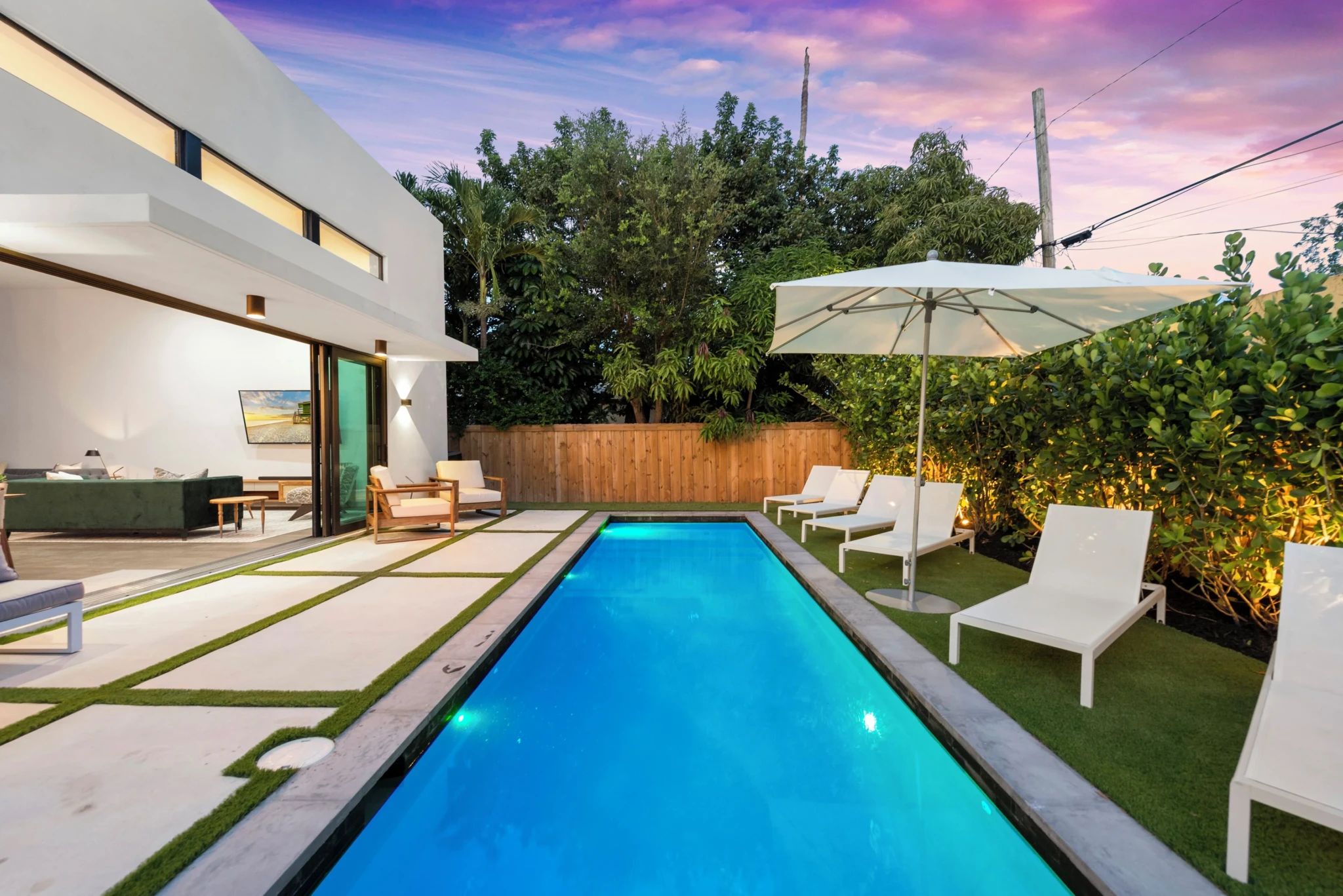
If your group is leaning toward the Design District for its galleries and restaurants but still wants a private pool to come home to, the Compound‘s two gated homes give you room to spread out without splitting the group across separate bookings. Check availability and book here.
Frequently Asked Questions
Is it cheaper to book a Miami vacation rental direct or through Airbnb or Vrbo?
Booking with the owner is typically cheaper because Airbnb and Vrbo add a service fee, often 10-15% of the nightly rate, on top of the base price. When you book on the property owner’s own site, that markup disappears and the disclosed total is usually what you pay, plus applicable taxes and the security deposit.
Which Retreats Miami properties allow pets?
Among Retreats Miami’s seven properties, 1430 in Brickell is the only one that’s explicitly pet-friendly, with a Pack and Play crib and high chair alongside its pet accommodations. The other properties, including 404th 360 Collins and 402nd 360 Collins, do not permit pets.
What’s the best Miami neighborhood for a bachelorette party?
Brickell and the Design District tend to fit bachelorette groups best because they offer larger villas with private pools, like 1430 or 520, without the strict quiet hours found in South Beach’s residential South of Fifth pocket. Groups wanting beach access and walkable nightlife should look further north along Collins Avenue instead of South of Fifth.
Do any Retreats Miami properties have a private pool or hot tub?
Yes. 1430 has a heated saltwater pool, 120 Shore has both a saltwater pool and a separately heated hot tub, and 530 has a heated plunge pool in a fully private backyard. The 520 villa and the Compound both include a pool as well.
How many bedrooms do I need for a family reunion of 10-12 people in Miami?
A reunion of 10-12 typically needs 4-6 bedrooms depending on how many couples are sharing rooms versus individual travelers. 120 Shore‘s six bedrooms and four bathrooms comfortably fit groups in this range, with two separate primary suites for parents who want privacy.
Is South Beach too crowded for a romantic getaway?
Not if you pick the right pocket. South of Fifth, at the southern tip of South Beach, is a quiet residential stretch with 10pm quiet hours, distinct from the louder Ocean Drive scene further north. A condo like 404th 360 Collins, one block from the sand in that quieter section, works well for couples.
What’s included when I book with the owner instead of through a third-party site?
Booking with the owner means the nightly rate, cleaning fee, and security deposit amount are disclosed upfront in a single conversation with the host, rather than calculated by a platform’s fee algorithm at checkout. You also get a direct line to the operator, which matters for questions about parking, check-in codes, or last-minute changes before arrival.
Content powered by inkSTR.co